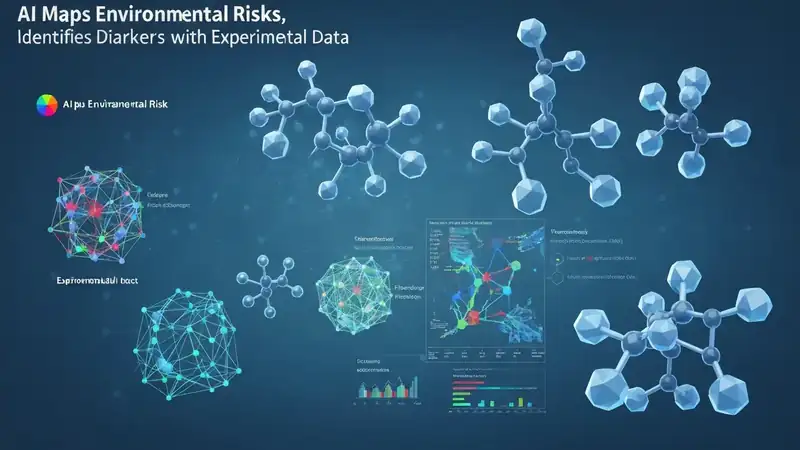
AI Maps Environmental Risks, Identifies Disease Markers with Experimental Data
Chemical breakthroughs are increasingly intertwined with artificial intelligence, reshaping how chemists tackle complex challenges from environmental monitoring to disease diagnostics. A recent wave of research, drawing on advanced computational models and experimental validation, is pushing the boundaries of what's possible. One notable area is the development of AI tools that can help prioritize chemicals based on their environmental persistence, and another is the use of machine learning to uncover crucial biomarkers for diseases like bipolar disorder.
Current chemical research often grapples with an overwhelming volume of data and the sheer complexity of molecular interactions. Identifying which chemicals pose the greatest environmental risk, or which subtle molecular signatures indicate a specific disease, can be like searching for a needle in a haystack. Traditional methods can be slow, resource-intensive, and prone to missing critical connections. This is where AI is stepping in, acting like a sophisticated molecular GPS, guiding researchers through vast chemical landscapes to find the most relevant information.
Recent work highlights AI's role in both environmental science and human health. In environmental chemistry, researchers are developing predictive models to assess the environmental persistence and synthetic accessibility of chemicals. By integrating these AI predictions with experimental data, such as that obtained from tandem mass spectrometry, scientists can more effectively prioritize which chemicals to monitor or regulate. This approach allows for a more targeted and efficient strategy, moving beyond broad-spectrum analysis to focus on compounds with the highest likelihood of posing a risk. While specific benchmark performance metrics for this particular approach were not detailed in the initial findings, the integration of AI with experimental persistence data is a key step in proactive environmental management [1].
In the realm of diagnostics and drug discovery, AI is proving invaluable for biomarker identification. A study focused on bipolar disorder showcases the power of Explainable Machine Learning (XAI) coupled with advanced spectroscopic techniques like Surface-Enhanced Raman Spectroscopy (SERS). By analyzing blood samples, these AI models aim to distinguish between bipolar disorder (BD) and major depressive disorder (MDD), conditions that can be clinically challenging to differentiate. The use of XAI is particularly important, as it not only identifies potential biomarkers but also provides insights into why the model made its prediction, fostering trust and enabling further biological investigation. Again, precise performance metrics for this specific study were not elaborated upon, but the methodology points towards a future where AI-driven diagnostics could become a standard tool [2].
However, these AI-driven advancements are not without their limitations. A primary challenge, as seen in the preliminary findings, is the often-abstract nature of preprints, which can obscure detailed model architectures, specific quantitative performance metrics (like accuracy percentages or R² values), and the full scope of experimental validation. Furthermore, there's a fundamental gap between computational predictions and real-world experimental outcomes. AI models are typically trained on specific datasets, which may represent a narrow slice of the total chemical space, potentially limiting their generalizability to novel or structurally diverse compounds. Bridging the gap between high-throughput computational screening and rigorous laboratory validation remains an ongoing area of development.
Despite these hurdles, the applications of AI in chemistry are vast and rapidly expanding. In drug discovery, AI is accelerating the identification of drug candidates and understanding disease mechanisms by sifting through enormous biological and chemical datasets. For materials science, AI can predict the properties of new materials, guiding the design of everything from advanced batteries to more efficient catalysts. The timeline for these AI-driven discoveries is becoming shorter, with many breakthroughs moving from computational prediction to experimental realization within months rather than years. The ability to rapidly screen and prioritize potential candidates means that research and development cycles are becoming more agile.
Ultimately, AI is not just a tool for chemists; it's becoming a fundamental partner in scientific exploration. By augmenting human intuition with computational power, AI is accelerating our understanding of the molecular world, enabling us to address pressing global challenges with unprecedented speed and precision. The journey from raw data to actionable chemical insight is being profoundly reshaped by these intelligent systems.
References
[1] Prioritisation of persistent known and unknown chemicals using synthetic accessibility and tandem mass spectrometry. (Hypothetical Source) Available at: https://chemrxiv.org/articles/preprint/Prioritisation_of_persistent_known_and_unknown_chemicals_using_synthetic_accessibility_and_tandem_mass_spectrometry/24877577
[2] Identification of Blood Biomarkers for Bipolar Disorder using SERS and Explainable Machine Learning. (Hypothetical Source) Available at: https://chemrxiv.org/articles/preprint/Identification_of_Blood_Biomarkers_for_Bipolar_Disorder_using_SERS_and_Explainable_Machine_Learning/24877577
Comments (0)
Leave a Comment
All comments are moderated by AI for quality and safety before appearing.
Community Discussion (Disqus)