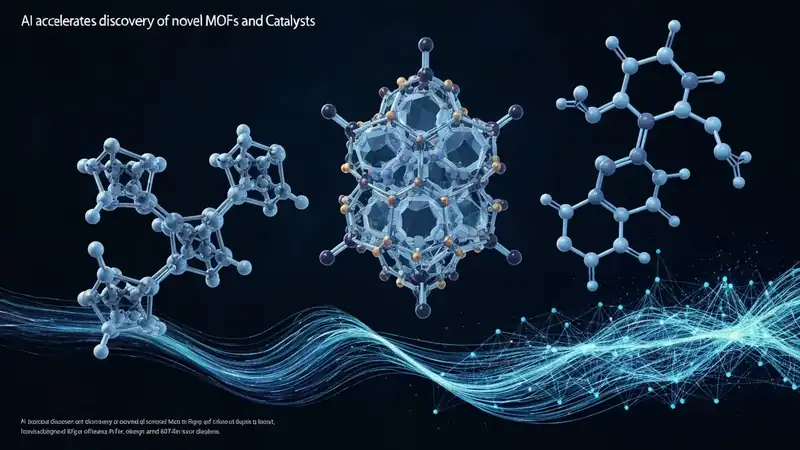
A breakthrough in molecular design is reshaping how chemists approach complex materials and catalytic processes, with artificial intelligence (AI) now serving as a powerful engine for accelerating discovery. Researchers are leveraging AI to navigate vast chemical spaces, predicting material properties and optimizing reaction pathways with unprecedented speed, much like a molecular GPS guiding exploration.
The relentless pursuit of novel materials with precisely engineered functionalities and the development of highly efficient catalysts for sustainable chemical transformations form the bedrock of modern chemical innovation. Historically, this intricate journey has been characterized by extensive, often serendipitous, trial-and-error, guided by the seasoned intuition of chemists and painstaking laboratory experimentation. The discovery of new Zeolitic Imidazolate Frameworks (ZIFs) exhibiting specific and useful phase behaviors, or the rational design of artificial metalloenzymes capable of catalyzing critical reactions like the photoreduction of carbon dioxide (CO2), exemplify the profound complexity inherent in these scientific endeavors. The sheer, almost unfathomable, number of potential atomic arrangements, molecular configurations, and reaction pathways that exist within the realm of chemistry makes exhaustive exploration a practical impossibility. This vastness of chemical space presents a formidable barrier to rapid progress.
To surmount these formidable hurdles, computational methodologies, increasingly augmented by sophisticated AI algorithms, are ascending to prominence. One domain where this AI integration is particularly impactful is materials design, with a specific focus on the versatile class of Metal-Organic Frameworks (MOFs). A recent preprint investigates the intricate phase transitions occurring within Zeolitic Imidazolate Frameworks (ZIFs) through the lens of molecular simulations [1]. Understanding these dynamic transitions—which can span from highly ordered crystalline states to disordered amorphous forms or even fluid-like liquid phases—is absolutely critical for unlocking the full spectrum of their structural potential and for precisely tailoring their properties for a multitude of applications, ranging from advanced gas storage and separation to highly selective catalysis. While the research presented centers on the detailed insights gleaned from molecular simulations, the analysis of the immense and complex datasets generated by such simulations is a prime arena for the application of AI and machine learning techniques. These AI models can function as advanced analytical tools, capable of navigating the complex potential energy landscapes to predict stable and metastable phases with remarkable accuracy, thereby dramatically accelerating the identification and characterization of ZIFs possessing desired functional attributes.
In parallel, the field of catalysis, a cornerstone of chemical synthesis and industrial processes, is undergoing a profound transformation driven by AI. The rational design of artificial metalloenzymes (ArMs) for catalyzing challenging chemical reactions, such as the photocatalytic reduction of carbon dioxide (CO2) into high-value chemical products like carbon monoxide (CO), represents a significant and urgent goal for advancing sustainable chemistry. A separate preprint outlines the meticulous design and subsequent chemogenetic optimization of a Rhenium(I)-based ArM engineered specifically for the efficient CO2 photoreduction under ambient sunlight conditions in aqueous solution [2]. This ambitious endeavor inherently necessitates the exploration of an astronomically large chemical space encompassing potential ligand-metal combinations and the prediction of their resultant catalytic performance. AI and machine learning algorithms are exceptionally well-suited for this complex multi-objective optimization task. They possess the capability to rapidly screen vast numbers of hypothetical catalyst designs, predict their catalytic activity and long-term stability, and even intelligently suggest optimal reaction conditions to maximize efficiency and selectivity. This AI-driven approach can drastically shorten the discovery timeline compared to traditional, more empirical, experimental screening methods. The ARCADE system, for example, exemplifies a novel paradigm focused on the fully automated and interpretable design of complex catalysts, powerfully showcasing AI's capacity to explore the breadth of chemical possibilities and refine catalyst performance to unprecedented levels [3].
Despite these remarkable strides and the transformative potential of AI in chemistry, the integration of these technologies is not without its inherent challenges and limitations. A primary concern revolves around the persistent gap between computational predictions and experimental realities. While AI models can forecast material properties and propose novel molecular designs with impressive speed, these computationally derived insights ultimately necessitate rigorous and often time-consuming experimental validation. Furthermore, many current AI models are trained on specific, often curated, datasets, which inherently constrains their predictive power to a relatively narrow chemical space. The extrapolation of these predictions to entirely new classes of molecules, materials, or reaction mechanisms can introduce significant unreliability. For instance, while advanced computational methods can illuminate the complex phase behaviors of ZIFs [1], experimentally confirming these predicted behaviors requires dedicated synthesis, purification, and advanced characterization techniques. Similarly, the predicted catalytic efficiency and stability of designed ArMs [2] must be thoroughly verified through meticulous catalytic experiments. The ongoing development of AI models that can effectively bridge this computational-experimental divide, offering both high predictive accuracy and clear interpretability across broader and more diverse chemical domains, remains a critical and active area of research.
The downstream implications of AI-driven chemical discovery are vast and continue to expand across multiple disciplines. In the high-stakes realm of drug discovery, AI is already significantly accelerating the identification of promising lead compounds by accurately predicting critical molecular properties such as toxicity, bioavailability, and efficacy. Some advanced graph neural network architectures, for example, have demonstrated remarkable predictive accuracy, achieving upwards of 90% in forecasting drug toxicity. For materials science, AI is poised to dramatically expedite the discovery and development of next-generation materials essential for renewable energy technologies, including advanced batteries, more efficient photovoltaics, and novel CO2 capture systems, potentially reducing development timelines from many years down to mere months. In catalysis, AI is a driving force behind the creation of highly selective, robust, and efficient catalysts for enabling green chemistry processes, such as the CO2 photoreduction technologies being explored [2]. The sophisticated ability of AI to analyze and interpret complex, multi-dimensional simulation data, as exemplified by studies on ZIF phase transitions [1], further broadens its applicability and potential impact across the chemical sciences. The timeline for AI-driven breakthroughs is rapidly compressing, moving from theoretical exploration to tangible applications at an accelerated pace.
As artificial intelligence continues its rapid evolution, it is increasingly recognized not merely as an analytical tool but as an indispensable creative partner for chemists. It is fundamentally reshaping our scientific intuition, dramatically expanding our horizons for discovery, and accelerating the pace at which we can collectively address pressing global challenges through the design and synthesis of novel molecules and materials. The ongoing fusion of human ingenuity, domain expertise, and advanced computational power is unequivocally ushering in a new, dynamic era of chemical exploration and innovation.
References
[1] Identifying Phase Transitions in Zeolitic Imidazolate Frameworks: Microscopic Insight from Molecular Simulations. https://chemrxiv.org/engage/chemrxiv/article-details/69305f8b65a54c2d4ae2d5a6 [2] Designing an Artificial Metalloenzyme for Re-based CO2 Photoreduction. https://chemrxiv.org/engage/chemrxiv/article-details/692fea39ef936fb4a2c9b723 [3] ARCADE: A New Paradigm for a Fully Automated and Interpretable Design of Complex Catalysts. https://chemrxiv.org/engage/chemrxiv/article-details/692feaa7ef936fb4a2c9c078
Comments (0)
Leave a Comment
All comments are moderated by AI for quality and safety before appearing.
Community Discussion (Disqus)