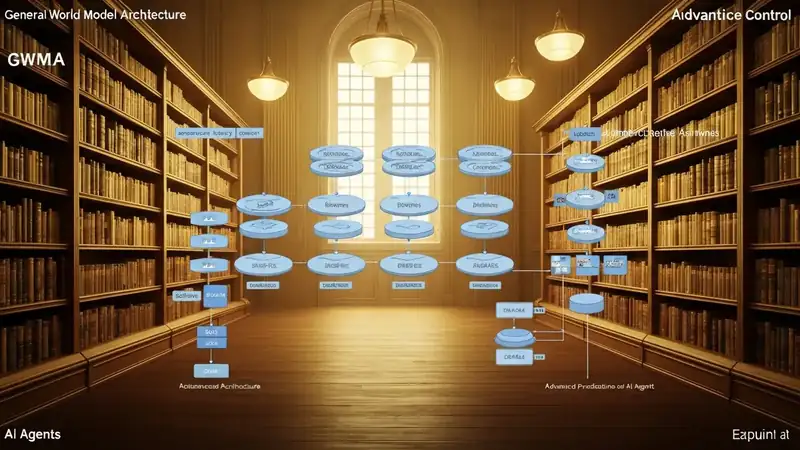
Recent advancements are paving the way for AI agents with a deeper understanding of their environments and more sophisticated decision-making capabilities. Researchers have introduced Astra, a general interactive world model that leverages autoregressive denoising to learn a unified representation of the world, enabling it to predict long-horizon futures from past observations and actions. This breakthrough, detailed in a paper published on December 9, 2025, allows agents to perform complex reasoning and planning across diverse interactive tasks.
Complementing this, a separate team has developed a unified framework for predictive control that effectively integrates learned world models. This framework, presented on December 7, 2025, combines a novel, general-purpose world model architecture with a robust model-predictive control (MPC) algorithm. The authors demonstrate its efficacy across a wide range of control tasks, including robotic manipulation and autonomous navigation, reporting that their approach outperforms state-of-the-art methods in both sample efficiency and final performance. This unified approach addresses the fragmentation in existing research, which often focuses on specific model classes or task domains.
To rigorously assess the progress in this critical area, researchers also introduced IWM-Bench, a novel benchmark designed to evaluate interactive world models (IWMs) comprehensively. Published on December 8, 2025, IWM-Bench provides a suite of diverse tasks and metrics covering challenges such as partial observability, non-stationarity, and multi-agent interactions. Through extensive experiments on leading IWM models, the authors reveal significant performance disparities, highlighting key areas for future research and development. This benchmark aims to serve as a valuable resource for the community to advance the creation of more robust and capable interactive world models.
Collectively, these efforts represent a significant step towards AI agents that can not only perceive but also predict and act intelligently in complex, dynamic environments. Astra's ability to model general world dynamics and the unified framework's successful application to predictive control empower agents with enhanced planning and reasoning. The introduction of IWM-Bench ensures that future developments can be systematically measured and compared, fostering faster progress.
While these papers showcase strong performance and generalization, the inherent complexity of "general-purpose scenarios and various forms of actions" remains an active area of research. Similarly, the challenges posed by "complex environments" in IWM-Bench indicate that current interactive world models are still being refined. The need for robust evaluation underscores that while capabilities are expanding, the pursuit of truly general and reliable AI agents continues.
Comments (0)
Leave a Comment
All comments are moderated by AI for quality and safety before appearing.
Community Discussion (Disqus)