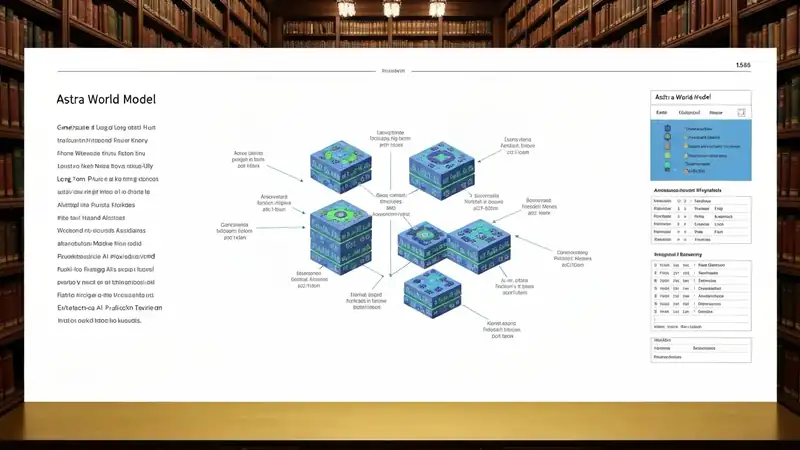
Researchers have introduced Astra, a novel interactive world model capable of predicting long-horizon futures from past observations and actions. This breakthrough, detailed in a recent arXiv preprint, significantly advances the field of generative AI for video and promises to enhance capabilities in robotics and AI planning.
Astra is built upon recent advancements in diffusion transformers, a class of models that have demonstrated remarkable success in generating high-quality video clips from textual or image prompts. Unlike previous diffusion models primarily focused on static generation or short-term predictions, Astra is designed as a "world model." This means it aims to understand and predict the dynamics of an environment over extended periods, incorporating both what the AI observes and the actions it takes. The autoregressive denoising approach allows Astra to generate future states sequentially, refining predictions at each step. While the abstract does not provide specific quantitative benchmarks for its long-horizon prediction capabilities, the core innovation lies in its generality and interactivity. It is designed to handle "various forms of actions" and operate in "general-purpose scenarios," suggesting a flexibility that moves beyond task-specific models. The underlying architecture leverages the power of transformers to process sequential data, enabling it to capture complex temporal dependencies crucial for understanding how actions unfold over time and influence future outcomes.
Prior work in video generation has largely focused on producing realistic and coherent short video clips, often conditioned on a single input like text. While impressive, these models typically do not possess an inherent understanding of causality or the ability to plan sequences of actions to achieve a goal. World models, on the other hand, aim to capture the underlying dynamics of an environment. Existing world models, however, have often been limited to specific domains (e.g., Atari games) or simpler forms of interaction. Astra's contribution is its generality and its ability to integrate interactive elements—observations and actions—into a unified framework for predicting extended futures. The "autoregressive denoising" aspect is key, allowing for a more stable and detailed generation process over long sequences compared to direct prediction methods. The authors' goal is to bridge the gap where current video generation excels at visual fidelity but lacks predictive understanding, and where existing world models are too constrained.
The implications of Astra are far-reaching. In robotics, such a model could enable robots to plan complex manipulation tasks with greater foresight, anticipating the consequences of their actions over longer durations. This is particularly relevant for tasks requiring fine motor skills and sequential operations, where understanding contact dynamics and environmental responses is critical. For AI agents in simulated or virtual environments, Astra could facilitate more sophisticated behaviors, allowing them to explore, learn, and achieve goals in dynamic settings. Furthermore, in content creation, it could lead to new tools for generating interactive narratives or simulations where future events are plausibly influenced by character actions. The ability to predict "long-horizon futures" also opens doors for more robust planning algorithms in autonomous systems, enabling them to make decisions that optimize for outcomes far into the future, rather than just immediate gains.
The abstract, while promising, does not detail specific quantitative performance metrics or rigorous evaluations against established benchmarks for long-horizon prediction. The generality and "various forms of actions" are stated goals, but the practical limits of this generality and the types of actions supported are not elaborated upon. Furthermore, the computational cost of training and running such complex autoregressive diffusion models for long sequences can be substantial, which might limit their deployment in resource-constrained environments. The "interactive" aspect implies a feedback loop, but the efficiency and responsiveness of this loop in real-time applications are not discussed. Finally, like many generative models, Astra's ability to avoid generating nonsensical or physically impossible futures over extremely long horizons will require further investigation and validation. The robustness of its world representation in novel or adversarial situations also remains an open question.
References
- Astra: General Interactive World Model with Autoregressive Denoising. Yixuan Zhu, Jiaqi Feng, Wenzhao Zheng et al. Published: 2025-12-09. URL: http://arxiv.org/abs/2512.08931v1
Comments (0)
Leave a Comment
All comments are moderated by AI for quality and safety before appearing.
Community Discussion (Disqus)